

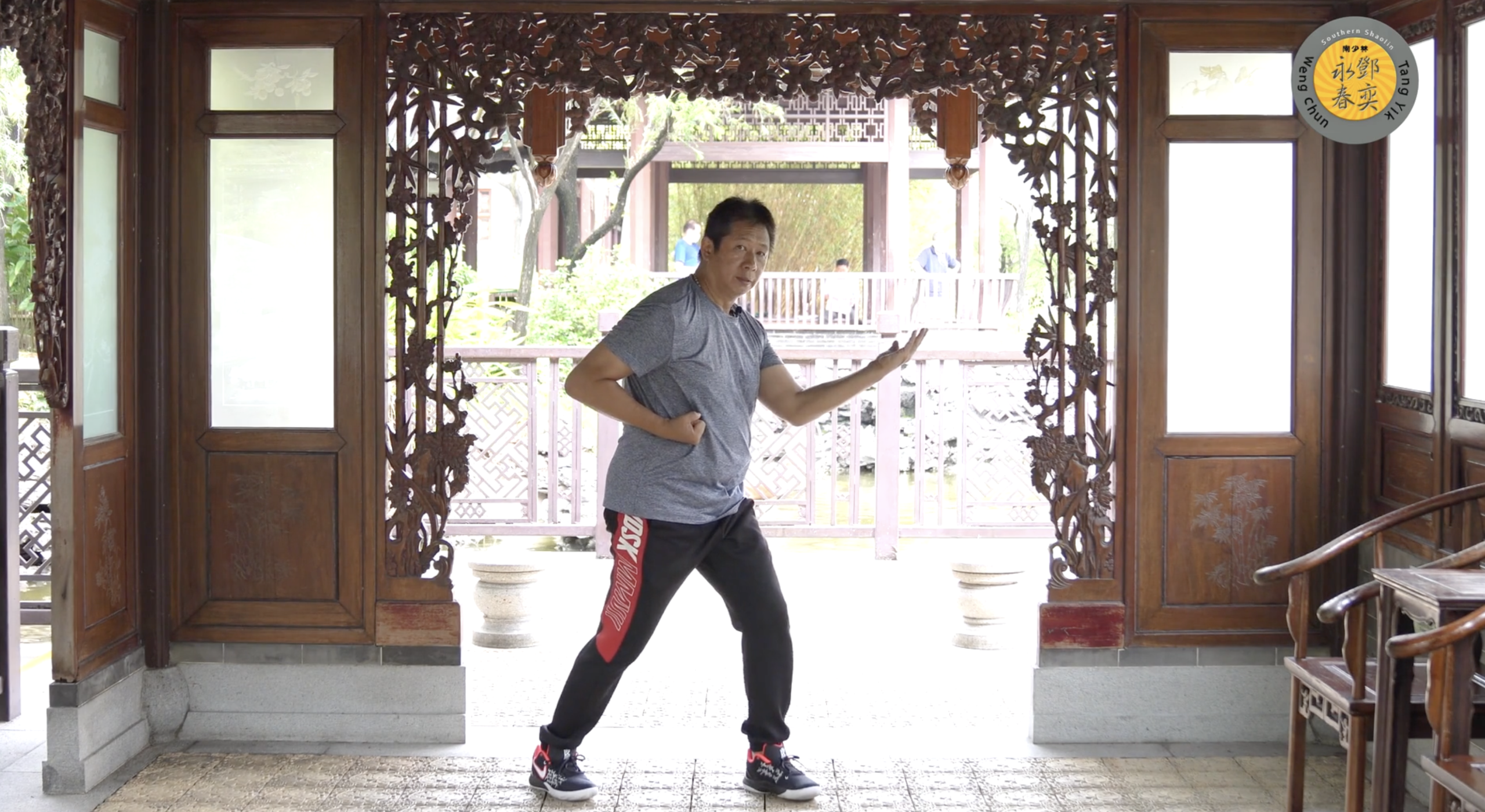
What Is Sap Yat Sao?
Sap Yat Sao consists of 11 continuous sections, bringing together many of the fundamental elements of Weng Chun.
Within the form, practitioners develop:
- Core Weng Chun hand techniques
- Correct body structure and alignment
- Stable rooting and connection to the ground
- Internal ging (勁) and power development
- Bridge-hand contact and control
- The integration of defence and offence
From the beginning, the movements are trained not simply as isolated techniques, but with an understanding of contact, transition and application.
The aim is economy and efficiency: learning how structure, timing and body mechanics can allow defence and offence to work together without unnecessary movement.
Why Sap Yat Sao Is the Foundation of Weng Chun
Sap Yat Sao can be regarded as the core of the Weng Chun system because it establishes the technical and energetic foundation required for more advanced training.
1. Bridge-Hand Skills
The form develops the fundamental qualities needed for bridge-hand contact: intercepting, sticking, redirecting force, controlling the opponent’s bridge, and combining defence with attack.
These qualities later become increasingly important in partner training and Chi Sao.
2. Body Structure and Alignment
Sap Yat Sao teaches the practitioner to maintain correct structural relationships throughout movement.
The shoulders remain relaxed and sunk, the elbows maintain their position, the body remains connected to the ground, and the stance provides a stable base from which force can be received and expressed.
Correct structure is essential. Without it, techniques may appear correct externally while lacking the qualities that make them effective.
3. Developing Ging
One of the deeper purposes of the form is the development of ging – trained martial power.
Rather than relying primarily on isolated muscular strength, the practitioner learns to connect the body so that power can travel from the ground, through the body, and into the arms and hands.
The result is a quality characteristic of Southern Chinese martial arts: the ability to combine softness and hardness, relaxation and explosive power.
4. Efficient Combat Principles
Sap Yat Sao also teaches an important principle of Weng Chun: defence and offence should not exist as completely separate actions.
Through repeated practice, movements become economical and transitions become increasingly natural.
From Sap Yat Sao to the Advanced Weng Chun Forms
The principles learned in Sap Yat Sao do not disappear when a practitioner progresses to more advanced material.
They become the foundation for it.
Sap Yat Sao initially develops these qualities through a relatively fixed and rooted structure. More advanced forms, including Seung Kong and Jong Kuen, build upon the same principles while introducing additional movement, footwork and methods of dynamic power generation.
For this reason, weaknesses in Sap Yat Sao will eventually become weaknesses in the advanced forms.
The better the foundation, the more naturally the later training can develop.
How to Practise Sap Yat Sao Effectively
Sap Yat Sao should never become an exercise in simply memorising choreography.
The purpose of practice is to refine structure, develop sensitivity, understand intention and cultivate relaxed short-range power.
Poor habits developed in the early stages can become increasingly difficult to correct later. Careful practice from the beginning is therefore far more valuable than rushing through the form.
1. Establish the Stance
Sap Yat Sao is initially practised from a fixed, rooted stance without stepping.
The knees should remain slightly bent and aligned naturally with the toes rather than collapsing inward. The hips sink naturally while the torso remains upright, without leaning excessively forward or backward.
Weight should remain balanced between both feet, avoiding unnecessary shifting or movement of the hips.
Most importantly, rooting should not be confused with stiffness.
If the legs begin trembling because of excessive tension, it is better to shorten the training period and gradually develop the stance. Genuine stability comes through relaxed sinking and correct structure rather than rigid muscular locking.
2. Relax the Upper Body and Breathe Naturally
The shoulders should remain relaxed and dropped throughout the form.
The elbows should maintain their structural relationship to the body rather than flaring outward, which weakens the bridge-hand structure and reduces sensitivity.
Excessive twisting of the torso should also be avoided. Power should develop through the connection between the ground, stance and body rather than through isolated arm strength.
Breathing remains natural. In particular, avoid holding the breath when practising Fa Ging or explosive movements, as unnecessary tension in the neck and shoulders interferes with power generation.
Three Stages of Sap Yat Sao Practice
The form can be developed progressively through three broad stages.
Phase 1: Slow and Precise Practice
For beginners, accuracy is more important than speed or power.
Learn each section carefully before rushing to complete the entire form. Practise slowly enough to observe whether the shoulders, elbows, centreline and stance remain correct throughout each transition.
The movements should flow continuously without becoming jerky or disconnected.
Short, regular sessions of approximately 15–25 minutes can be more productive than occasional long sessions performed with poor concentration.
At this stage, the objective is simple:
Build the correct movement and structure first. Power comes later.
Phase 2: Developing Sensitivity and Intention
Once the 11 sections can be performed comfortably, the practitioner can begin to place greater emphasis on martial intention and bridge-hand contact.
Instead of moving through empty space, imagine maintaining light contact with an opponent’s forearms. Each movement should have a purpose: receiving, sticking, redirecting, controlling or attacking.
At this stage, the Four Elements of Weng Chun can also be expressed more clearly within the form:
- Earth — stability, rooting and structural integrity
- Water — softness, adaptability and continuous sticking
- Fire — short, sharp expression of power when required
- Wind — yielding, changing and redirecting incoming force
The purpose is not to artificially imitate these qualities, but gradually to understand how they appear within movement.
Both sides of the body should be trained carefully to prevent an excessive dependence on the dominant hand.
Phase 3: Refining Power and Timing
At an advanced level, structure and relaxation must remain present even when greater speed and power are introduced.
A useful approach is to keep the majority of practice slow, controlled and structurally precise, introducing short-range Fa Ging only when the body can remain relaxed.
Power should appear at the required moment and disappear immediately afterwards.
The practitioner should avoid remaining tense after issuing force.
Individual sections that remain weak can also be isolated and repeated rather than always performing the entire form from beginning to end.
Advanced practice is therefore not necessarily about doing more. Often, it is about returning to the same movement and understanding it at a deeper level.
Partner Training: Bringing the Form to Life
Solo practice provides the foundation, but Sap Yat Sao cannot be fully understood through solo training alone.
Partner exercises allow the practitioner to experience pressure, contact, timing, distance and changes in force that cannot be reproduced in the air.
This is where the bridge-hand principles contained within the form begin to become functional martial skills.
The form and the partner work should continually inform one another.
If a movement appears correct in solo practice but repeatedly fails under partner pressure, the practitioner should return to the form and examine the structure, intention and mechanics behind it.
Common Mistakes in Sap Yat Sao Practice
Even experienced practitioners should remain aware of several common problems.
1. Rushing for Speed
Fast practice performed with poor structure simply reinforces poor habits. Precision should come before speed.
2. Raising the Shoulders or Flaring the Elbows
These habits weaken the bridge structure and introduce unnecessary muscular tension.
3. Using Too Much Arm Strength
Weng Chun power should come from the connected body and its relationship with the ground, rather than from the arms alone.
4. Holding the Breath
Breath-holding creates unnecessary tension, particularly through the shoulders and neck, and interferes with relaxed power.
5. Rushing Past the Foundations
Every section of Sap Yat Sao contributes something to the system. Skipping basic material creates gaps that become more obvious at advanced levels.
6. Neglecting Partner Practice
Solo training develops structure, but tactile sensitivity must be developed through contact with another practitioner.
A Form for a Lifetime
Sap Yat Sao should not be viewed as a form that belongs only to beginners.
Even advanced practitioners can benefit from returning regularly to slow practice, using the form to correct small changes in posture, tension and structure that naturally develop over time.
The relationship between form and application should always remain alive.
If a technique works beautifully in the form but consistently fails in partner training, something is missing. Likewise, partner practice without a strong technical foundation can gradually lose the principles that give Weng Chun its particular character.
The more advanced Seung Kong and Jong Kuen training becomes, the more important this foundation is.
In this sense, Sap Yat Sao is not merely the first Weng Chun form.
It is a form to which the practitioner returns throughout a lifetime of training.
Learn Sap Yat Sao and the Complete Weng Chun System
For practitioners who wish to study these methods in greater depth, I teach Sap Yat Sao and its applications as part of the complete Tang Yik Weng Chun system through the Experience Weng Chun Online Academy.
The training goes beyond the form itself and includes the Four Elements of Weng Chun, Sap Yat Sao applications, Seung Kong, 23 Chi Sao sets, 11 two-man sets, the complete weapons system, Long Pole training, and specialised Weng Chun internal power training.
The purpose is to preserve these methods while making the traditional transmission available to dedicated practitioners around the world.